
Septic System Installation Harrisburg, PA
Professional septic system installation in Harrisburg, PA with full permitting and compliance.
Local Septic System Installation Expertise
In Harrisburg, PA, we handle septic system installation for new construction, additions, and properties transitioning from municipal sewer. Your system works quietly below ground—until it doesn't. Our permitting and installation ensure compliance with state regulations and decades of trouble-free operation.
Every septic system installation in Harrisburg, PA starts with proper site assessment and ends with final inspection.
How We Work
Our process moves in stages: assess your property, design the system, obtain permits, prepare the site, and install with full oversight.
Site Assessment & Design
We evaluate soil conditions, lot slope, groundwater depth, and proximity to wells or water sources. Harrisburg-area properties range from dense urban residential to suburban and rural sites, each with unique soil profiles and drainage challenges.
Our team conducts percolation testing and soil analysis to determine system type and size. Pennsylvania law requires specific tank sizes based on bedroom count—a three-bedroom home needs at least a 900-gallon tank. We design for your actual household needs, not just the minimum.
Permits & Pre-Installation Coordination
We submit your system design to the local Sewage Enforcement Officer for approval. The permit protects your property and your neighbors by ensuring your system meets state and municipal standards.
We schedule inspections, coordinate utility locates, and confirm soil and weather conditions before breaking ground. Every detail gets verified before installation begins.
Excavation & Tank Installation
We excavate to the correct depth, prepare a stable bed, and position your septic tank. Tanks must rest on solid ground and be set to proper grade.
Tank material—concrete, fiberglass, or plastic—is selected based on your soil and site conditions. Each tank gets backfilled, compacted, and inspected before we move to the drain field.
Evaluate Soil & Grade
Confirm lot slope and subsurface conditions meet code for gravity or pressure system.
Obtain Local Permit
Submit design to Dauphin County Sewage Enforcement Officer for approval.
Excavate & Install Tank
Set tank to grade with proper backfill and compaction on level, stable base.
Build Drain Field
Lay distribution piping in aggregate bed sized for soil percolation rate.
Final Inspection
Sewage Enforcement Officer inspects system before cover, final grading, and use approval.
Document & Maintain
Keep system diagram and pump records on hand. Regular maintenance extends system life.
You'll always know what's happening next—and when.
Our Services
We handle complete septic system installation and related site work across Harrisburg and surrounding areas.
Conventional Gravity Systems
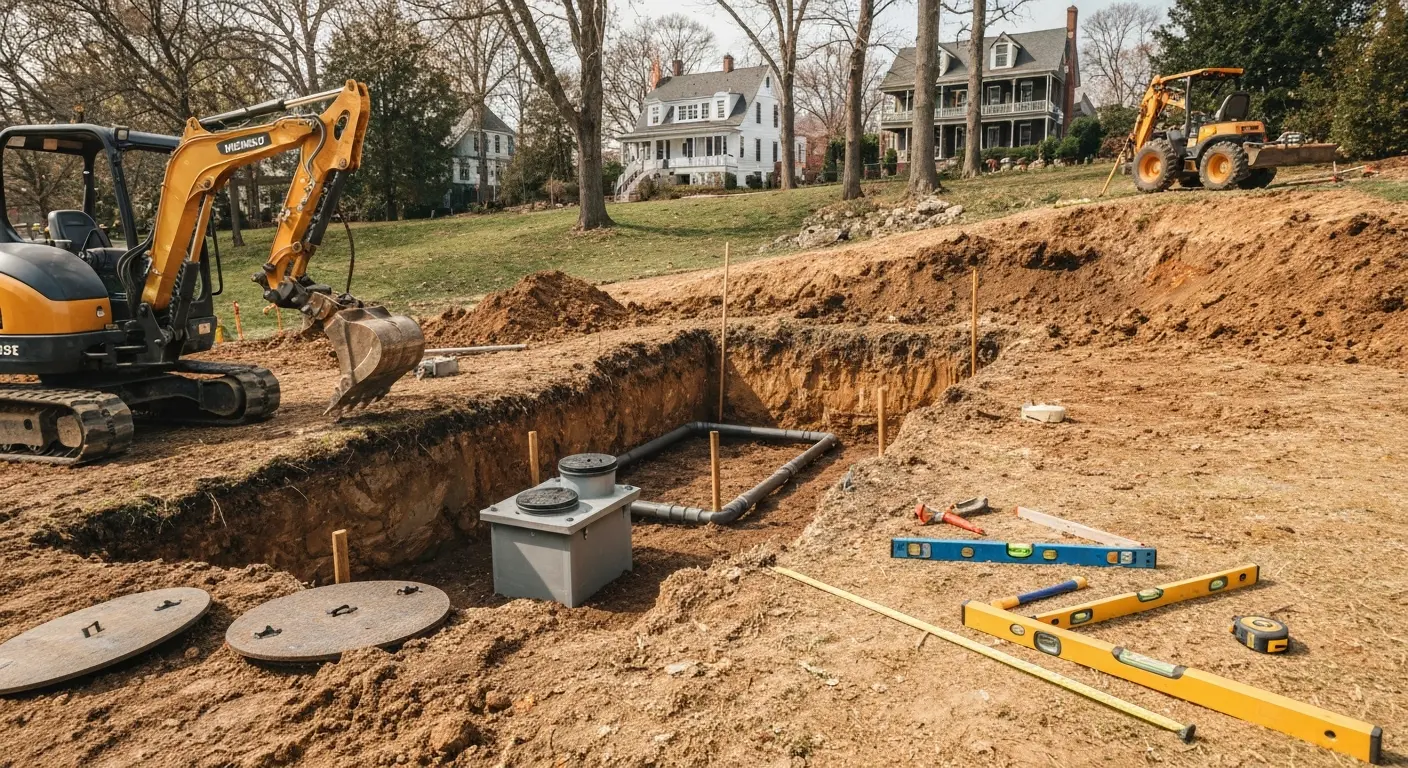
Gravity-fed septic system in Midtown Harrisburg—no pump required for downslope drain fields.
Most Harrisburg properties benefit from gravity flow. Sewage moves from tank to drain field by slope alone—no electricity, fewer moving parts, lower maintenance.
Gravity systems work best when your lot slopes toward the drain field and soil percolation rates fall within Pennsylvania standards. We assess site contours and ground conditions to confirm feasibility.
Tank size depends on bedroom count and household usage patterns. Proper design ensures years of reliable operation.
Pressure Distribution Systems
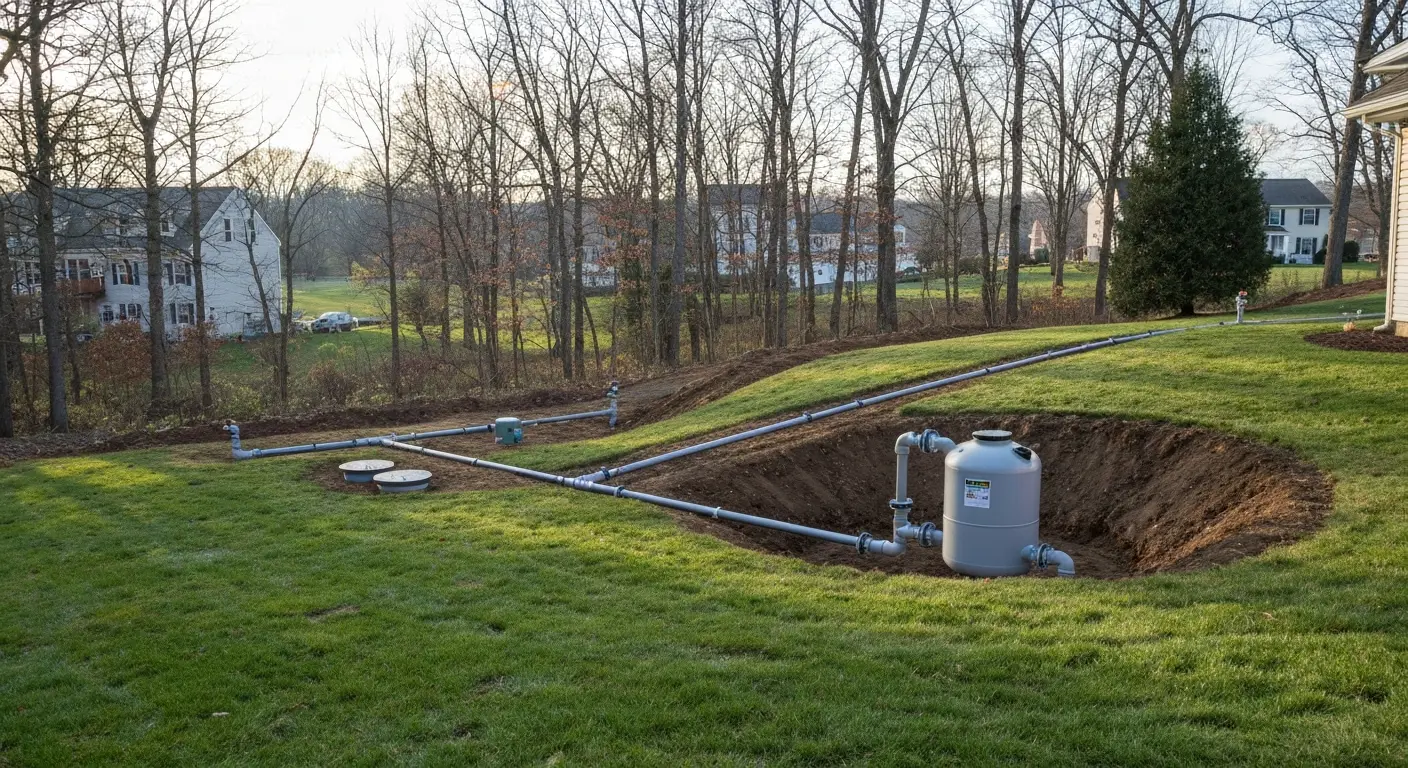
Pump tank and distribution lines for sloped or challenging soil sites in Colonial Park and surrounding areas.
When gravity won't work—upslope drain field, shallow soil, or tight lot—pressure systems pump treated effluent on a timer.
These systems reach sites gravity cannot and handle higher flows on small lots. The pump adds mechanical equipment that requires annual service, but the payoff is placement flexibility.
We install, program, and maintain pumps and alarm systems so you know if anything goes wrong.
Sand Mound & Alternative Systems
Some Harrisburg-area lots have shallow bedrock, high water tables, or tight soil conditions. Sand mounds and other approved alternatives treat these sites without costly relocation.
We design and install sand mounds, constructed wetlands, and aerobic treatment systems where needed. Each requires permitting and ongoing maintenance, but opens installation possibilities on difficult properties.
Excavation & Site Prep
Septic installation involves serious earthwork—excavation, grading, and final site restoration. We handle it all.
From removing trees and stumps to managing soil, compacting fill, and final grading, we leave your property clean and ready. Proper site restoration protects the system from surface water and keeps drainage away from tank and field.
Why It Matters
A properly installed septic system protects your water supply, your neighbors' wells, and the Susquehanna River. Mistakes are expensive and often irreversible.
Compliance With Pennsylvania Code & Local Law
Pennsylvania's Act 537 and local municipal codes set strict standards for septic design, installation, and maintenance. Dauphin County's Sewage Enforcement Officer enforces these rules to protect public health and groundwater.
Unpermitted or improper systems face fines, mandatory removal, and liability. We guide every project through permitting, inspections, and final approval—no shortcuts.
Pennsylvania law requires tank sizes of at least 900 gallons for a three-bedroom home. Upsize if your household is larger or water use is high.
Long-Term Reliability & Resale Value
A well-installed septic system runs 25–40 years with routine pumping and care. Buyers and lenders expect proper permits and documentation—your system's record matters.
System failures during home sales kill deals or crater offers. Proper installation upfront saves thousands in repairs and uncertainty later. We provide permits and diagrams so you have proof of quality installation.
Routine maintenance—pumping every 3–5 years, avoiding heavy vehicles over the field, protecting the drain field from trees—extends system life and prevents costly emergency repairs.
Serving Harrisburg & Surrounding Areas
We service Harrisburg and nearby municipalities where septic systems are the primary sewage disposal.
Dauphin County Expertise
Dauphin County spans dense urban Harrisburg to rural townships. Soil types, regulations, and lot conditions vary widely across the region.
From Allison Hill's older homes to sprawling properties in Lower Paxton and Susquehanna Township, we understand local site challenges. High water tables near the Susquehanna River, clay-heavy soils in upland areas, and slope issues all shape system design.
We coordinate with the Dauphin County Sewage Enforcement Officer and respect each municipality's specific permitting processes and review cycles.
Fast Permitting & Flexible Scheduling
Permits typically take 2–4 weeks. Installation timing depends on weather, site conditions, and inspection schedules. We plan around your calendar and site readiness.
Call us early so we can assess your lot and move forward with confidence. The sooner we evaluate conditions, the sooner we can secure permits and schedule work.
Featured Insight
What's the typical timeline for septic system installation in Harrisburg?
End-to-end, expect 6–12 weeks from initial consultation to system approval. Breakdown:
- Weeks 1–2: Site assessment, soil testing, design
- Weeks 2–4: Permit application and SEO review
- Weeks 4–8: Installation (3–5 days of active work, plus inspections)
- Weeks 8–12: Final inspection, approval, and handoff
Weather delays, permit reviews, and inspection scheduling affect the timeline. We keep you updated every step.
Get in touch early—early assessment means faster permits and less waiting.
Frequently Asked Questions
Common questions about septic system installation in Harrisburg, PA
Do I need a permit to install a septic system in Harrisburg?
Yes. Pennsylvania law and Dauphin County code require a permit from the Sewage Enforcement Officer before installation. Unpermitted systems face fines and mandatory removal. We handle the entire permit process.
How big should my septic tank be?
Pennsylvania requires a minimum 900-gallon tank for a three-bedroom home. Larger households or high water use may need 1,000–1,500 gallons. We size based on bedrooms and usage patterns to avoid overload.
Can my lot support a septic system?
Not all sites work with standard gravity systems. Soil, slope, water table, and lot size all matter. We test soil percolation and depth to determine feasibility. Challenging sites may need pressure systems, sand mounds, or alternatives.
How often should a septic tank be pumped?
Most systems need pumping every 3–5 years depending on tank size and household size. Larger families use more water and need more frequent pumping. We recommend tracking system maintenance with written records.
What can I do to protect my septic system?
Keep heavy vehicles off the drain field, divert rainwater away from the tank and field, avoid planting trees near the system, and limit water use. Don't flush non-biodegradable items. Conserve water whenever possible.
Can I build an addition or install a pool near my septic system?
No. You need 10–50+ feet clearance depending on system type and local code. Keep all structures and equipment off the drain field. Consult us or the SEO before any construction near your system.
DISCOVER WHAT OUR CUSTOMERS HAVE TO SAY ABOUT US
REVIEWS
proudly serving these areas
Annville, PA
Camp Hill, PA
Carlisle, PA
Dillsburg, PA
Enola, PA
Ephrata, PA
Etters, PA
Grantville, PA
READY TO take the next step?
get a free quote TODAY!
QUICK LINKS
our services
service areas
operating HOURS
Mon: 7:00 am - 4:00 pm
Tue: 7:00 am - 4:00 pm
Wed: 7:00 am - 4:00 pm
Thu: 7:00 am - 4:00 pm
Fri: 7:00 am - 4:00 pm
Sat: Closed - Closed
Sun: Closed - Closed